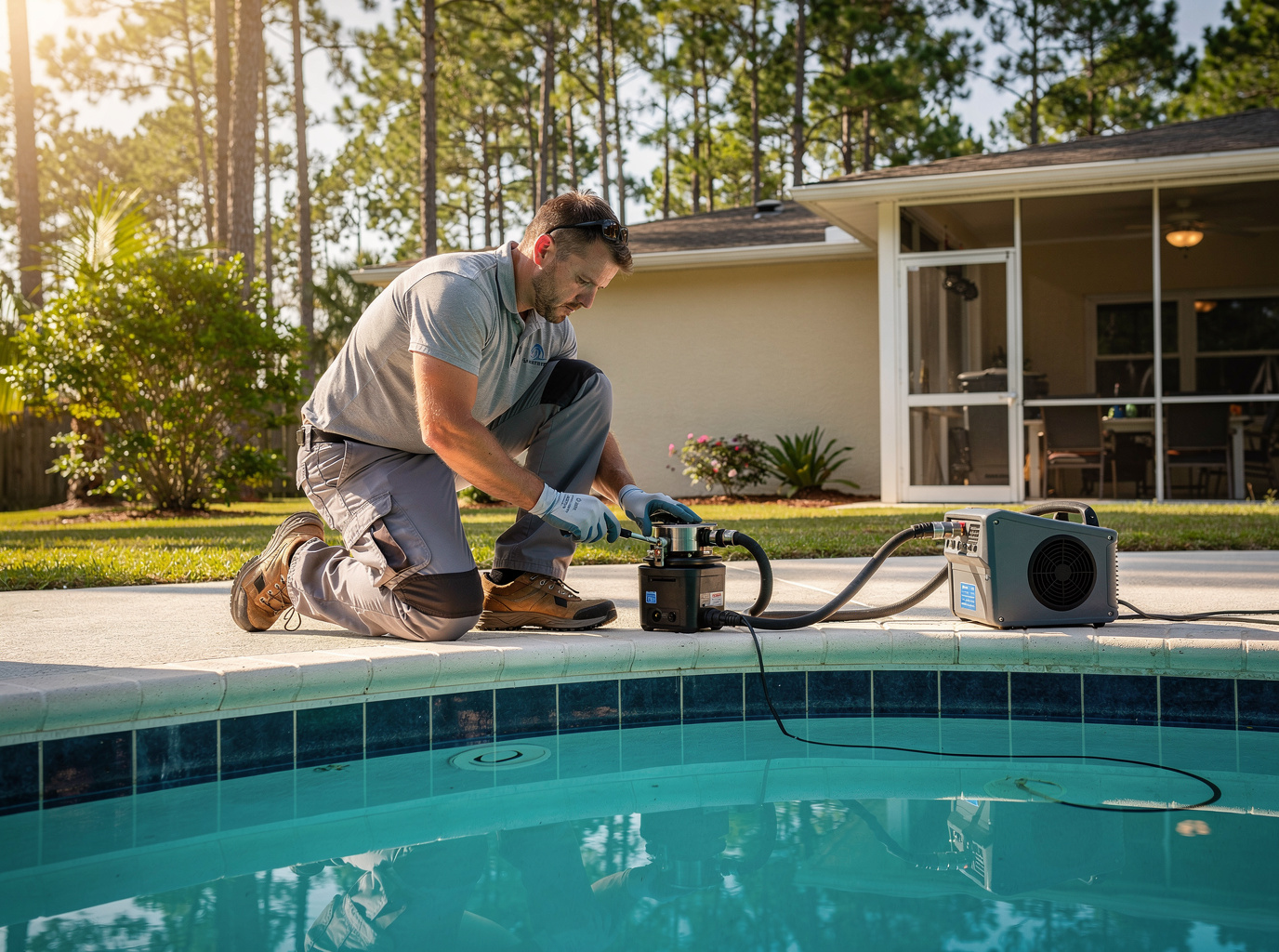
Swimming pools in Tallahassee face intense environmental strain due to our humid subtropical climate, marked by sweltering summers and damp, mild winters. In neighborhoods like Killearn Estates, where many homes feature established gunite and vinyl pools shaded by mature live oaks, shifting soil and heavy root systems frequently displace underground suction and return plumbing. When underground pipes crack or settled shells develop hairline fissures, water loss accelerates rapidly. Standard evaporation accounts for roughly a quarter-inch of water loss daily under hot summer sun; anything beyond that usually signals a physical breach in the plumbing matrix, shell, or light niche.
Finding an inground leak requires methodical isolation rather than speculative digging. In communities such as Southwood or Midtown, local clay-heavy soils can retain thousands of gallons of escaping pool water before any surface pooling ever reveals itself, leading to compromised deck footings and washouts under surrounding concrete pads. We use non-invasive acoustic listening gear, electronic line tracers, and hydrophone listening probes to track down sub-surface pressure leaks along skimmer lines, main drains, and multi-port valve configurations without tearing up your backyard paver deck or patio.
Pool Leak Detection Near You — Choose Your City
Every city below has its own local Pool Leak Detection page with coverage details.
We also specialize in testing the structural components of the vessel itself. Vinyl liners in student rentals near College Town or properties closer to Florida State University often suffer micro-tears from wear or debris that go unnoticed during routine maintenance. Using sensitive low-voltage electric field locators and targeted dye testing around hydrostatic relief valves, return fittings, and conduit penetrations, we map the exact entry and exit points of water movement. Pinpointing the breach on the front end prevents unneeded structural demolition and protects your Leon County property from underlying soil destabilization.
Technician insight
In Tallahassee, the thing that catches most people out with pool leak detection is the deceptive clay soil around areas like Killearn Estates and Southwood. When a suction or return line cracks underground, the dense red clay can trap and channel water away for months without bubbling up through the sod, quietly undermining the concrete pool deck until massive voids form beneath the slab.
Unexplained Water Loss in Killearn Estates Inground Pool
A homeowner in Killearn Estates noticed their pool was dropping two inches of water daily, suspecting heavy summer evaporation. Acoustic equipment and pressure testing isolated a significant pressure drop on the primary return line buried beneath four inches of stamped concrete. We traced the subterranean hiss to a severed PVC elbow sheared by expanding oak tree roots, allowing the owner to cut only a single tile space for repairs instead of excavating their entire deck.
Pool Leak Detection Services We Offer
✓Underground Plumbing Pressure Testing
Isolates and pressurizes skimmer lines, returns, and main drains with air and water to confirm pipe integrity below pool decks.
✓Pool Shell Dye Injection Testing
Uses concentrated, non-toxic diagnostic dye under calm water conditions to identify water draw at structural cracks and fittings.
✓Electronic Vinyl Liner Scanning
Deploys low-voltage electrical current across the pool liner to locate pinpoint punctures and microscopic tears along seams.
✓Skimmer Throat and Collar Inspection
Detects structural separation and seal failures where skimmer boxes bond to pool walls, a common failure point in settling soils.
✓Underwater Light Niche Conduit Testing
Locates breaches along the unsealed electrical conduit lines running behind pool fixtures, stopping invisible drainage behind pool walls.
✓Hydrostatic Relief Valve Testing
Checks the spring and seal of deep-end hydrostatic valves that can stick open and drain pool water directly into high groundwater tables.
Pool Leak Detection Cost in Florida
| Service | Typical Range | What Affects It |
|---|---|---|
| Basic Single-Line Pressure Test | $250–$400 | Standard pools with basic skimmer and return setups; verifies if plumbing holds pressure. |
| Full Inground Structural & Plumbing Diagnostic | $450–$800 | Comprehensive testing of lines, shell, light fixtures, and skimmer throats on residential pools. |
| Pool and Attached Spa Combination Diagnostic | $600–$1,100 | Complex systems with secondary blowers, spillways, multiple returns, and extensive manifold valves. |
| Electronic Vinyl Liner Hole Scan | $350–$550 | Dedicated electrical field sweep to identify micro-punctures throughout the entire liner surface. |
Ranges are typical for Florida and confirmed with an exact written quote before any work starts.
How it works
- 1
Evaporation Isolation and Level Baseline
We review baseline water loss over a controlled period to differentiate environmental evaporation from an active, pressurized or structural leak.
- 2
Equipment Pad and Valve Pressure Check
We inspect pumps, filters, heaters, and chlorinators for suction leaks, failing shaft seals, and bypass leaks discharging through backwash lines.
- 3
Underground Line Pressure Isolation
Each line—including skimmer, dedicated cleaner, main drain, and return loops—is mechanically plugged and pressurized to detect pressure drops.
- 4
Hydrophone and Acoustic Sonar Tracking
If an underground line loses pressure, acoustic listening probes follow the run to map the precise location of the rupture under concrete or soil.
- 5
Structural Dye and Penetration Audit
We systematically dye-test fittings, stairs, returns, light niches, and drain housings to catch any structural shell water loss.
Pricing
Pool leak detection fees are driven primarily by the size of the pool, the number of plumbing lines (spas, waterfalls, multi-skimmers), and whether the shell is vinyl, fiberglass, or concrete.