Slab leaks across Leon County present unique structural hazards due to the underlying geology and local building traditions. In communities like Killearn Estates, many homes constructed in the 1970s and 1980s feature copper supply lines routed directly through or beneath poured concrete slabs without protective sleeves. Over decades, Tallahassee's humid subtropical climate—marked by intense, hot summers and high groundwater tables—interacts with shifting, clay-heavy soils. This soil movement causes friction against the unshielded copper, while internal water chemistry gradually thins pipe walls. When a pressurized line fails beneath the foundation, the escaping water quickly saturates the sub-base, risking foundation settling, buckled flooring, and severe moisture intrusion that fosters rapid mold growth in our humid climate.
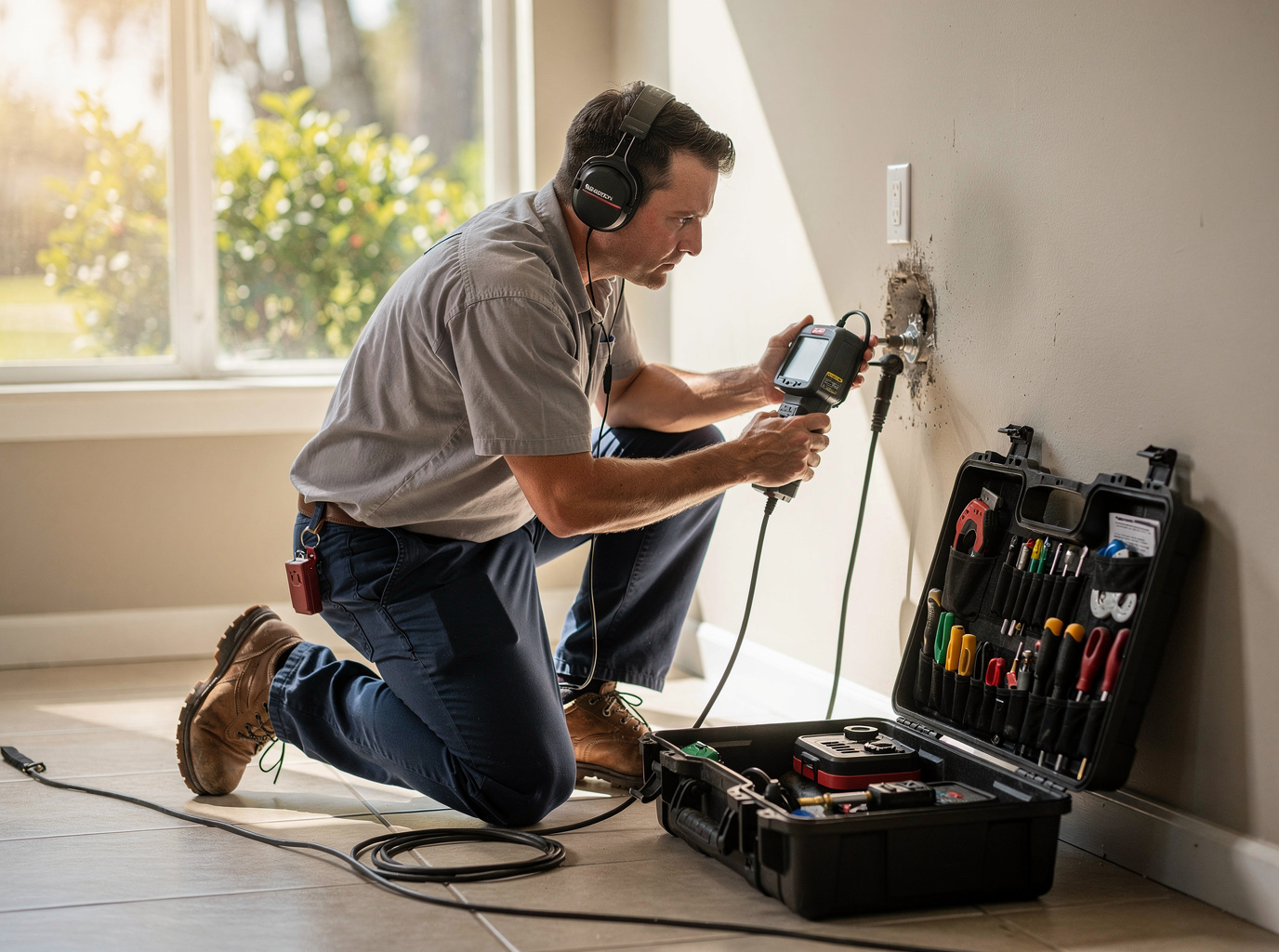
Pinpointing a foundation leak requires an exact diagnostic progression rather than exploratory jackhammering. When investigating properties near Midtown or Southwood, we begin by isolating the municipal supply and monitoring the water meter alongside static pressure testing to determine whether the failure affects the hot or cold potable system. We then deploy high-frequency acoustic ground microphones and correlation equipment to listen for the distinct sonic signature of pressurized water escaping through aggregate. Thermal imaging cameras track abnormal heat blooms along floors caused by hot-water slab lines, while helium tracer gas is introduced into drained lines to escape through minute hairline fractures in concrete. This non-destructive strategy isolates the rupture within inches, saving valuable hardwood, tile, and structural integrity.
Slab Leak Detection Near You — Choose Your City
Every city below has its own local Slab Leak Detection page with coverage details.
Locating a sub-slab failure is only the first half of the equation; confirming the viability of surrounding infrastructure determines the correct remedy. In multi-family dwellings near College Town or commercial spaces closer to Downtown by the Florida State Capitol, a single pinhole often indicates systemic corrosion throughout the entire sub-slab manifold. Rather than tunneling beneath the slab or breaking up decorative concrete, locating the exact breach informs whether a targeted spot repair or an overhead PEX bypass through the attic is the smarter long-term solution. Because regional building codes demand strict adherence to foundation stability and backflow prevention, accurately documenting the breach ensures that subsequent slab leak repair plans preserve structural compliance without leaving secondary weak points hidden underground.
Common Signs of a Foundation Plumbing Leak
Tallahassee homeowners should stay vigilant for several telltale indicators of sub-slab failure before catastrophic water damage occurs:
- An unexplained spike in your City of Tallahassee utility bill despite normal household consumption.
- Noticeable warm spots on carpet, hardwood, or tile floors, indicating a hot-water line breach.
- The persistent sound of rushing or hissing water when all plumbing fixtures and irrigation systems are turned off.
- Damp, darkening baseboards or spongy floorboards along interior partition walls.
- Hairline cracks emerging along drywall seams or exterior brick veneer due to localized foundation settlement.
- Sudden drops in water pressure when multiple fixtures run simultaneously.
Technician insight
In Tallahassee, the thing that catches most people out with slab leak detection is assuming a warm floor patch near the kitchen means the leak is right underneath it. With our expansive clay soils and the way water travels along aggregate beds beneath older homes in Killearn Estates, water often migrates twenty feet along the path of least resistance before pooling. Relying on temperature alone without dual-frequency acoustic verification almost always results in tearing up the wrong section of tile.
Concealed Hot-Water Slab Leak in a Killearn Estates Ranch Home
A homeowner noticed warm engineered wood flooring in a central hallway and a running water sound whenever their irrigation shut down. We performed static line testing, isolating the failure to the hot-water supply manifold, then utilized infrared thermography paired with acoustic listening probes across the slab. We pinpointed a pinhole corrosion pit directly beneath an adjacent bathroom threshold rather than the warm spot ten feet away, allowing a targeted single-tile excavation that resolved the leak without disturbing the rest of the living area.
Slab Leak Detection Services We Offer
✓Acoustic Ground Microphone Survey
Utilizing precision sonic transducers to listen through concrete slabs and pinpoint the specific frequency of pressurized sub-surface water leaks.
✓Infrared Thermal Imaging
Deploying radiometric thermal cameras to detect subtle surface temperature differentials created by ruptured hot-water lines beneath flooring.
✓Tracer Gas Leak Pinpointing
Injecting non-toxic, non-flammable tracer gas mixtures into evacuated lines to identify micro-fissures beneath thick concrete foundations.
✓Static Pressure Manifold Testing
Isolating plumbing loops to verify pressure drops across distinct zones and confirm whether leaks originate in domestic hot or cold lines.
✓Pre-Repair Jackhammer Mapping
Providing precise floor-marking to minimize concrete demolition and preserve interior finishes prior to invasive plumbing excavations.
✓Under-Slab Sewer Camera Inspection
Running high-definition video inspection probes through sub-slab drain lines to identify fractures, root intrusion, or soil washouts.
Slab Leak Detection Cost in Florida
| Service | Typical Range | What Affects It |
|---|---|---|
| Residential Single-Story Slab Leak Detection | $325–$550 | Standard acoustic and thermal diagnostic for homes under 2,500 sq ft. |
| Multi-Story or Large Footprint Detection | $450–$750 | Properties over 2,500 sq ft or homes with multiple split slab foundations. |
| Tracer Gas Verification Service | $200–$350 | Add-on for complex, micro-volume pinhole leaks in heavily insulated foundations. |
| Commercial Slab Leak Diagnostic | $600–$1,200 | Covers retail, restaurant, and office foundations with high ambient background noise. |
Ranges are typical for Florida and confirmed with an exact written quote before any work starts.
How it works
- 1
Pressure Drop & System Isolation
We shut down all visible plumbing fixtures, attach calibrated pressure gauges to the system, and confirm whether the pressure loss stems from the main hot or cold line.
- 2
Acoustic & Thermal Localization
Technicians scan the property using thermal imaging to track thermal signatures, followed by acoustic listening disks that filter ambient noise to isolate the sub-slab rupture.
- 3
Tracer Gas Confirmation
For tiny pinholes or heavily insulated deep-slab lines, we introduce safe tracer gas into the depressurized line and track its emergence using specialized gas sniffers.
- 4
Mapping & Repair Consultation
We mark the exact failure point on your flooring surface and provide a diagnostic assessment outlining the leak location to guide your plumber's repair work.
Pricing
Diagnostic pricing is typically a flat fee based on property square footage and foundation complexity, with transparent upfront quotes provided before testing begins.