Underground wastewater lines across Leon County face distinct structural pressures created by our humid subtropical climate and varied geology. In older communities like Midtown and near Downtown, vintage cast iron and vitrified clay sewer lines have spent decades absorbing seasonal moisture swings, resulting in brittle pipe walls, bottom-channel corrosion, and shifting joints. During long, hot summers, aggressive root systems from mature live oaks and pines drive deeply into the soil seeking moisture, exploiting microscopic pipe fissures. When sewer gas odors linger near the Florida State Capitol or slow drains recur near Florida State University student properties, standard snaking often misses the real culprit: a compromised pipe wall steadily leaching wastewater beneath your foundation.
A cracked or separated sewer line rarely presents as a dramatic indoor geyser; instead, it slowly destabilizes the surrounding substrate. In master-planned developments like Southwood or the rolling terrain of Killearn Estates, expansive clay soils swell during heavy summer downpours and contract sharply during drier stretches. This cyclical ground movement places immense shear stress on PVC and ABS lateral joints. Wastewater escaping into the sub-base erodes supporting fill, creating underground voids that eventually cause foundation settling or sinkholes. Because sewer leaks often mirror a clean water leak or a recurring water leak detection issue, identifying the true source requires eliminating clean-water supply lines before isolating the drain-waste-vent network.
Sewer Line Leak Detection Near You — Choose Your City
Every city below has its own local Sewer Line Leak Detection page with coverage details.
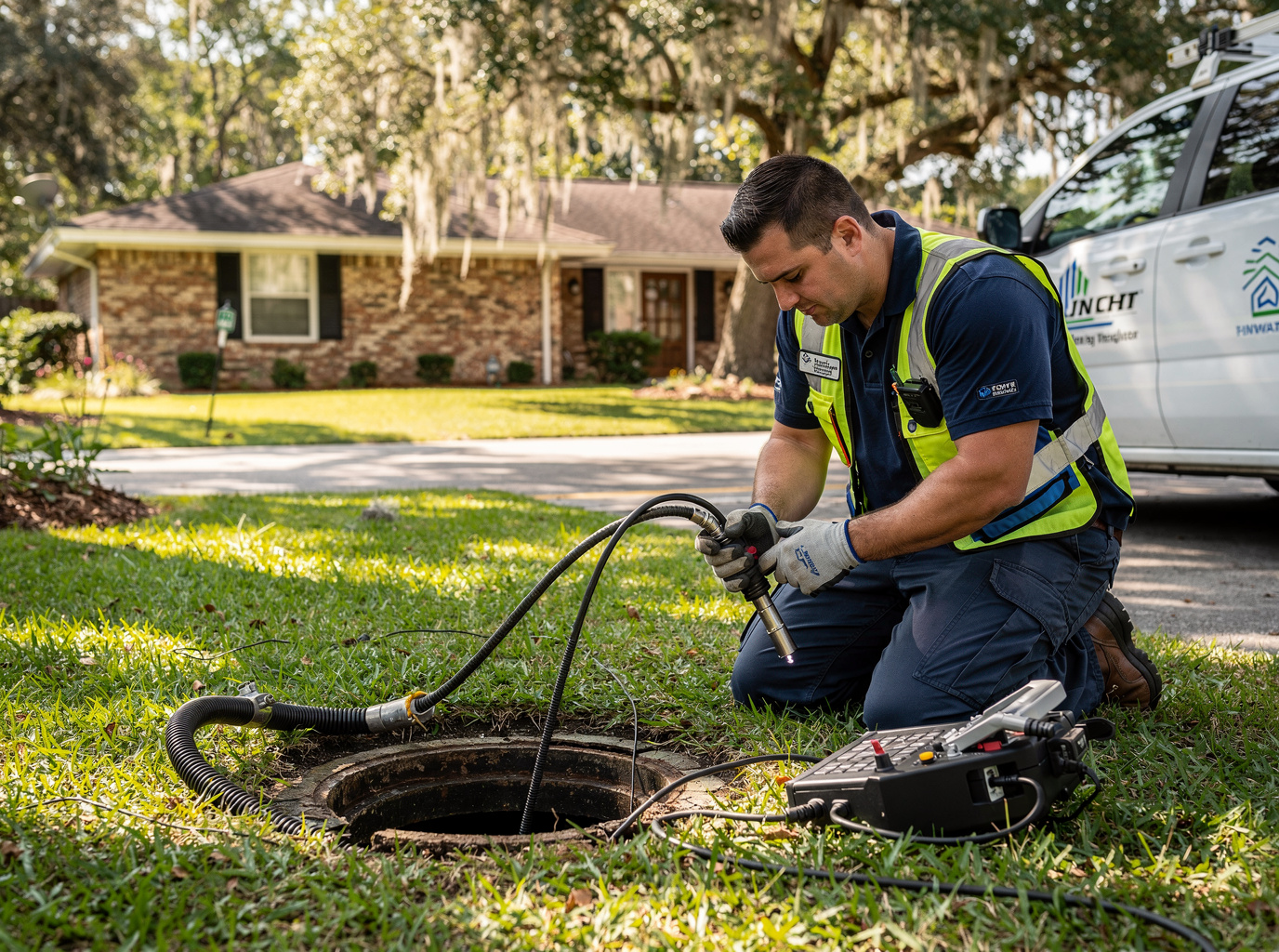
Locating a sub-surface sewer leak demands non-invasive testing methods tailored to local building practices. Many homes built in the mid-to-late twentieth century feature unmapped cleanouts, buried directional transitions, or long runs through heavily landscaped yards. We deploy self-leveling HD sewer inspection cameras with integrated 512 Hz sondes alongside hydrostatic isolation test plugs. By isolating segments of the drain line and tracking pressure drops, we pinpoint exactly where the integrity failure sits without indiscriminate digging. Addressing these failures promptly prevents secondary damage that often mimics a structural foundation failure, saving homeowners from catastrophic slab leak repair complications down the road.
Sewer Leaks vs. Clean Water Slab Leaks
Property owners often mistake a broken sewer lateral for a pressurized supply line issue. While a clean water leak keeps your municipal meter spinning constantly even when no fixtures run, a sewer line leak only discharges fluid when fixtures drain or when wastewater sits static in a compromised belly. Furthermore, cracked sewer lines allow subterranean moisture and soil to enter the line during heavy rain events, leading to sudden, unexplained indoor fixture backups. If you notice damp baseboards, localized foul odors, or lush patches of lawn during dry weeks without an abnormal utility bill spike, you are likely dealing with a drain-waste-vent breach rather than a pressurized supply pipe.
Technician insight
In Tallahassee, the thing that catches most people out with Sewer Line Leak Detection is assuming an unexplained damp spot on a slab is always a pressurized water supply line. In established neighborhoods like Midtown or near College Town, older cast iron waste stacks frequently rot out along the bottom crown of the pipe, leaking wastewater directly under the slab only when sinks or tubs drain. Because this doesn't run the clean water meter, people live with structural foundation softening for months before realizing the drain lateral itself has failed.
Persistent Foundation Dampness in an Established Killearn Home
A homeowner in Killearn Estates noticed recurring musty odors along an interior hallway wall, but city water meter checks showed zero flow when plumbing was idle. We introduced an inspection camera with a 512 Hz sonde through the exterior cleanout and identified an offset joint cracked by aggressive oak roots ten feet inward beneath the slab. Using an above-ground radio locator, we traced the fracture to an exact point beneath a bathroom subfloor. Pinpointing the failure allowed a plumbing contractor to cut an isolated two-foot floor section rather than tearing up the entire master bedroom.
Sewer Line Leak Detection Services We Offer
✓High-Definition Sewer Camera Inspection
Optical internal evaluation using continuous-feed push cameras to visually uncover cracked hubs, root penetrations, and offset joints without digging up your yard.
✓Hydrostatic Sewer Isolation Testing
Precision pressure-decay testing using inflatable pneumatic test balls to isolate and confirm sub-slab drain leaks section by section.
✓Under-Slab Sewer Leak Detection
Specialized acoustic and electronic tracing to identify broken sewer laterals running directly beneath concrete slab foundations before structural damage occurs.
✓Sewer Sonde Line Tracing and Depth Mapping
Electromagnetic radio-detection locating that maps the precise path, bends, and depth of buried sewer mains through landscaping, driveways, or patios.
✓Commercial Kitchen and Rental Property Waste Line Audits
Comprehensive drain line evaluations tailored for high-use multi-family properties and food-service facilities around College Town and Midtown.
Sewer Line Leak Detection Cost in Florida
| Service | Typical Range | What Affects It |
|---|---|---|
| Standard Lateral Camera Inspection | $250–$450 | Requires accessible ground-level cleanout; covers camera push and video review. |
| Hydrostatic Under-Slab Sewer Isolation Test | $400–$750 | Includes pneumatic isolation plugs, filling lines, and pressure drop testing across branches. |
| Complete Video Inspection with Sonde Line Locating | $350–$600 | Includes visual pipe assessment plus physical surface staking of line depth and leak coordinates. |
| Roof Vent Access Sewer Camera Inspection | $450–$700 | Required on vintage properties lacking accessible outdoor cleanouts where roof pulling is necessary. |
Ranges are typical for Florida and confirmed with an exact written quote before any work starts.
How it works
- 1
Initial Site Assessment and Visual Drain Review
We inspect property grade, cleanout access points, and indoor fixtures, checking for sewer gas odors, soil depression, or unexplained moisture patterns near foundations.
- 2
HD Video Pipeline Inspection
A high-resolution sewer camera is guided through your lateral line to inspect interior walls, identify fractures, locate root blockages, and check for pipe bellies.
- 3
Hydrostatic and Static Head Isolation
Pneumatic plugs are placed at designated cleanouts to fill lateral sections with water, monitoring fluid levels to verify if and where wastewater is escaping the piping network.
- 4
Electromagnetic Surface Locating
When a break is found, we activate an in-line transmitter sonde and locate it from above ground, marking the exact spot and depth on your turf, slab, or driveway.
- 5
Diagnostic Report and Repair Roadmap
You receive a clear assessment detailing pipe condition, leak location, depth, and actionable recommendations so your plumbing contractor can excavate precisely.
Pricing
Diagnostic sewer line leak detection is priced as an upfront flat evaluation fee, determined by site accessibility, presence of ground-level cleanouts, and line complexity.